

Environmentally Adaptive, Low CO2 Emission Process, Low-Cost Solid-State Batteries - A Challenge for Social Change with Aqueous Recycling
Environmentally Adaptive, Low CO2 Emission Process, Low-Cost Solid-State Batteries - A Challenge for Social Change with Aqueous Recycling
Shintaro Yasui Laboratory
Background and Objectives
Although burning liquid LIBs are inexpensive and have become a fixture in our lives, geopolitical risks and recycling considerations have made it likely that battery passports will become mandatory after 2030. Solid-state batteries currently being developed are mainly sulfide-based, and it goes without saying that they are dangerous due to the generation of H2S gas upon exposure to the atmosphere. We are developing a new solid-state battery using a standby handling water-based process that is environmentally friendly and does not require a dry room or organic solvent drying process. Although the drive condition of this battery is 2.35V, its energy density is equivalent to that of liquid LIBs, and we expect to commercialize it as a stationary battery that can be used safely without spreading fire.
Research
- Developed a new low-cost and safe electrolyte that can be produced under atmospheric conditions, making good use of the much-disliked "water.
- Demonstration of lithium (sodium) ion rechargeable batteries fabricated under all-atmospheric conditions for driving and stationary use.
- Establishment of a new battery recycling system (society)
GX Expected effects of technological development
The use of rechargeable batteries is absolutely essential for high efficiency of energy consumption, and low CO2 emission process, low cost, and safety will be absolute requirements considering the social situation after 2030.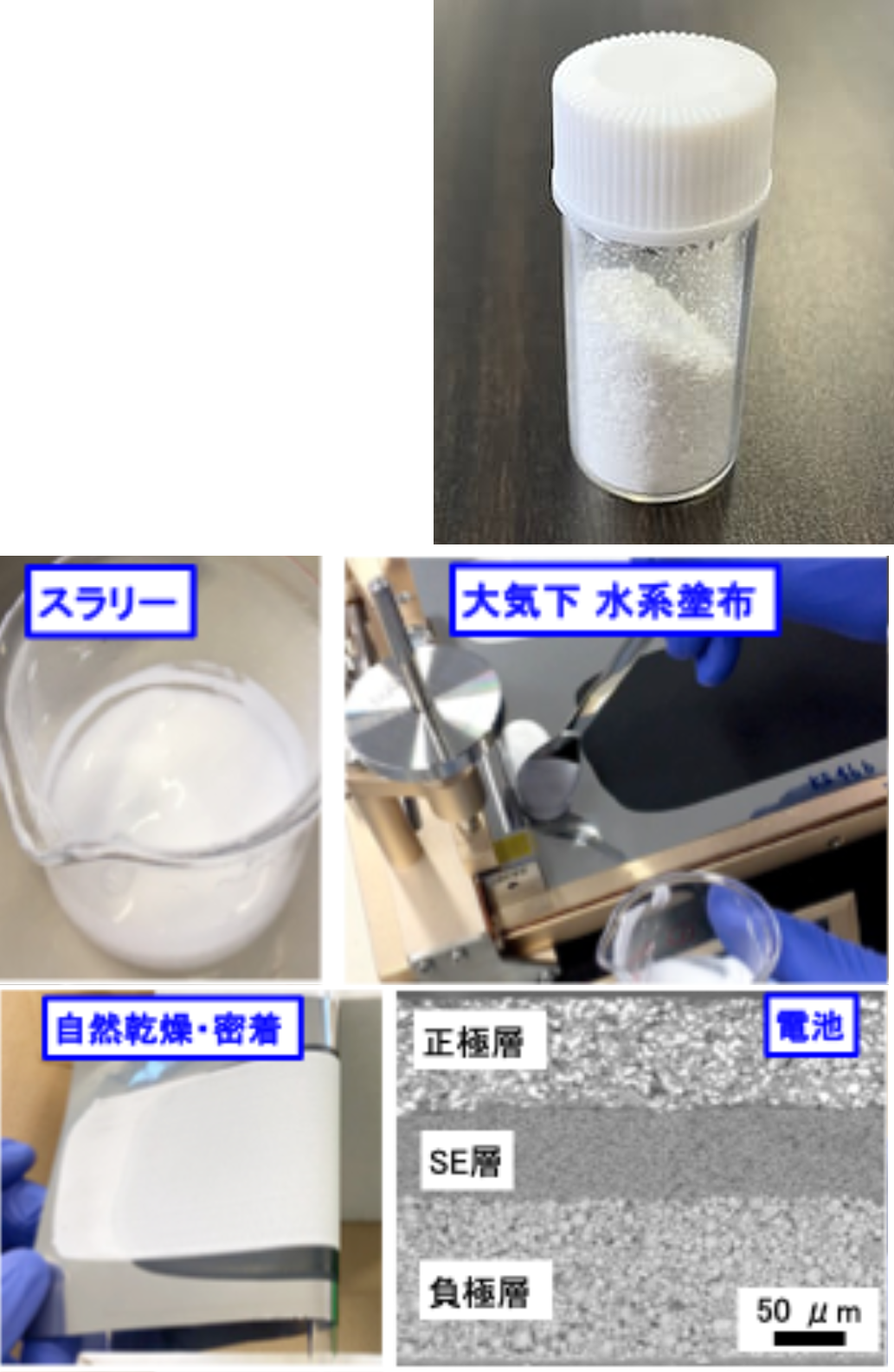
Solid Electrolytes for All-Solid-State Batteries Fabricated under Atmospheric Conditions and Battery Production Process
Nihon Keizai Shimbun, "Coating and drying electrolytes Tokyo Institute of Technology " 8/30 Nikkei Online
https://www.nikkei.com/article/DGXZQOUC27B1O0X20C23A7000000/