

HyTES Demonstration Test to Realize Re-Energy Thermal Energy Storage Power Generation by Coupling CaO/H2O Chemical Heat Pump and Sensible Heat Storage
HyTES Demonstration Test to Realize Re-Energy Thermal Energy Storage Power Generation by Coupling CaO/H2O Chemical Heat Pump and Sensible Heat Storage
Yuki Kato Laboratory
Background and Objectives
HyTES combines sensible heat with a chemical heat pump (CHP) to achieve 500°C heat storage and 600°C high-temperature output. HyTES can contribute to CN through effective use of renewable energy.Research
A safe, low-cost, thermally reactive heat storage block using a calcium hydroxide/water system has been developed and demonstrated for the first time in the world for high-temperature CHP at 600°C. HyTES can output heat at a constant temperature by coupling with CHP. This is the only system in the world that uses molten salt as the heat-transfer medium, which enables high efficiency heat-transfer operation at ambient pressure. The research will improve materials, scale up the equipment, and optimize the system for social implementation.GX Expected effects of technological development
Although the storage and generation efficiency is lower than LIB batteries, the overall system cost is lower and the LCA environmental impact is smaller. The same cost is inexpensive for hydrogen systems. The GX technology is safe, the materials are safe, it is inexpensive, can be handled with domestically produced materials and technologies, and has high social implementability. The output control of domestic renewable energy is expected to exceed 100 TWh/y (about 2 trillion yen/year) in the future, and the storage of large amounts of renewable energy at low cost is important, so this system has a high social contribution potential. By utilizing thermal power generation facilities that are not needed, converting surplus renewable energy to electric heat and storing it, and generating electricity with a steam turbine using the stored heat when necessary, the system can reduce CO2It is possible to generate renewable energy thermal energy storage with inertia and no emissions. It can also be applied to the heat utilization industry.
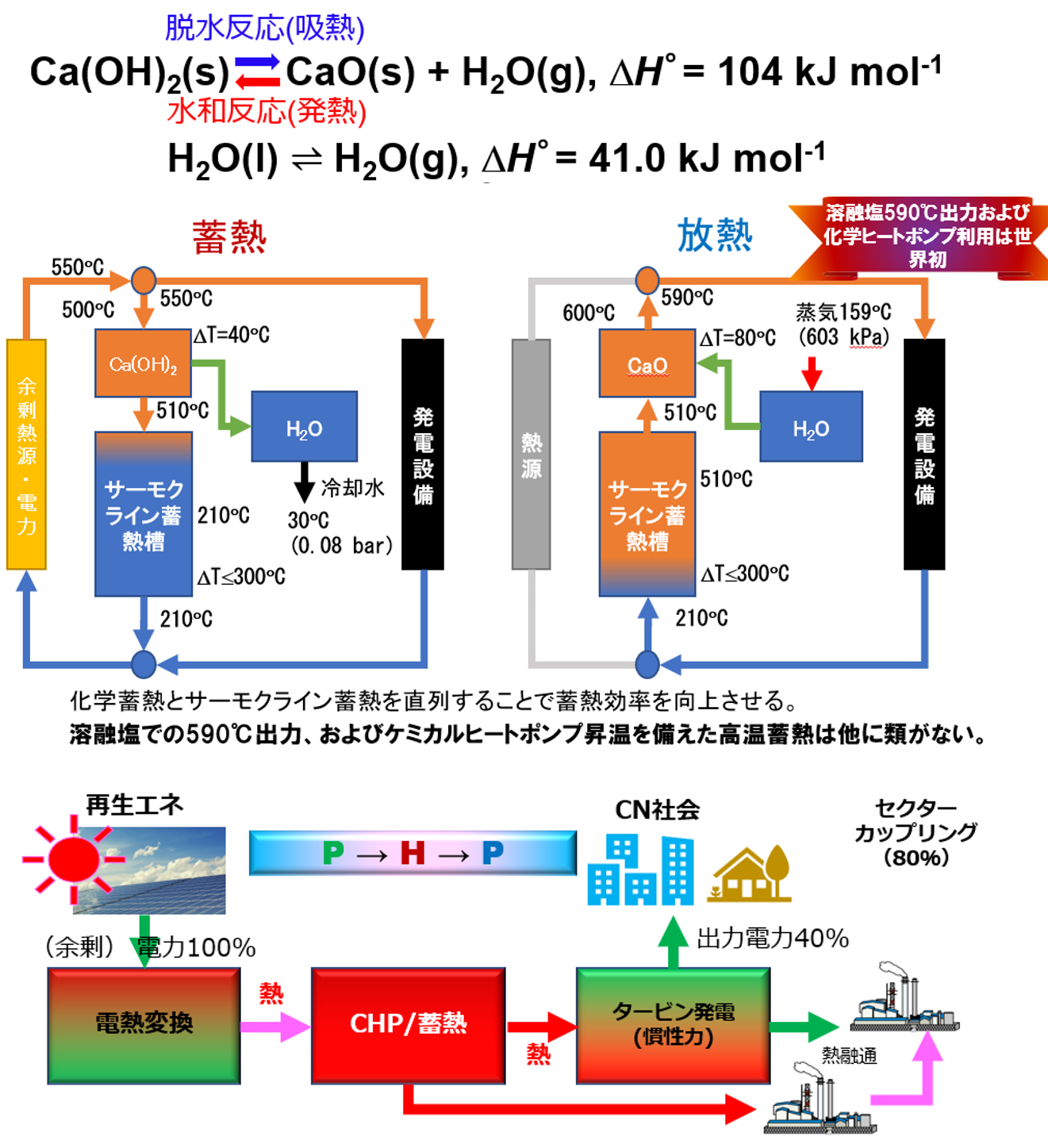
Basic configuration ofpowerthermal energy storage and generation system (P2H2P) (CHP: chemical heat pump)
1,Purchase renewable energy at low cost and sell power at times of high demand
2. energy storage power generation system that costs less than storage batteries and can be easily scaled up for large-scale applications
3. turbine power generation, which has inertia in supplying power that storage batteries do not have. This is essential for stable supply of renewable energy power with fluctuating output.
4. highly efficient use of high-temperature heat through direct industrial use, sector coupling use
5. research and development ahead in Germany, the EU, the U.S., etc.