

Development of Surface Modification Technology Using Localized Plasma Ion Implantation with Laser-Generated Drift Plasma
Development of Surface Modification Technology Using Localized Plasma Ion Implantation with Laser-Generated Drift Plasma
Hasegawa Jun Laboratory
Background and Objectives
Plasma Ion Implantation (PBII) is a technology that applies a negative pulsed high voltage to a substrate placed in a plasma, irradiating and implanting ions accelerated by the surrounding sheath onto the substrate.It is suitable for surface modification of mechanical parts with complex three-dimensional shapes. Compared to other film deposition techniques, it has the following characteristics: substrate temperature can be maintained at room temperature, film thicknesses of 10 µm or more can be achieved, adhesion strength to the substrate can be controlled, and film deposition is possible on non-metallic substrates (such as resins).This research explores a more flexible and efficient surface modification technology by newly utilizing high-density plasma locally generated by a laser as the plasma source for PBII.
Research
We are conducting proof-of-concept experiments for PBII using laser-generated drift plasma. To achieve DLC deposition on the inner surface of cylindrical substrates with high aspect ratios—previously difficult—we are exploring optimal plasma generation conditions and pulse voltage application conditions. Through plasma analysis using 2D numerical simulations and min of ion-implanted substrates, we elucidate the mechanism of this proposed method and identify challenges.
GX Expected effects of technological development
PBII film deposition technology offers significant improvements in the wear resistance and lubricity of mechanical components. Its applications across industry are extremely broad, making it an indispensable GX technology for realizing a resource- and energy-saving society.
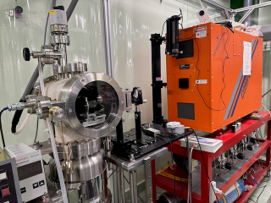
Drift Plasma Ion Injection Test Device Under Development